Finding the right educational toys ideas can feel overwhelming — store shelves are packed with options that promise learning but rarely explain what that actually looks like in real play. The truth is, the best educational toys feel like pure fun to a child while quietly building skills like problem-solving, coordination, language, and creativity behind the scenes. This guide breaks down exactly what to look for, which toys deliver real value at every age, and how to make smart choices without wasting money.
Furthermore, you do not need to spend a fortune or chase every new trend. Many of the most effective educational toys are surprisingly simple — and they earn a permanent spot in the playroom because children keep returning to them on their own.
Quick Takeaway: The strongest educational toy is the one your child actually uses — repeatedly, happily, and with growing confidence. Engagement always comes before curriculum.
A meaningful educational toy gives children something to do, not just something to watch. Stacking, sorting, building, experimenting, pretending — all of these actions help young minds connect what they observe with how the world actually works. As a result, active, hands-on play consistently outperforms passive screen-based entertainment for skill development in early childhood, a finding supported by NAEYC research on play and development.
It also helps to rethink what “educational” even means. Young children learn through repetition, movement, curiosity, and imagination — not through formal lessons. For example, a shape sorter builds early logic. A pretend kitchen supports vocabulary and social development. A set of wooden blocks can teach spatial awareness, patience, and confidence all at once.
In contrast, toys that rely on flashing lights, loud sounds, or pre-programmed responses often grab attention initially but fade quickly. The child becomes a spectator rather than a participant.
Developmental needs shift rapidly in early childhood. Therefore, the most useful way to explore educational toys ideas is to organize them by age and developmental stage — so you can match the toy to exactly where your child is right now.
For babies, educational play centers on sensory exploration. Soft activity gyms, textured rattles, tummy-time mirrors, high-contrast cards, and simple stacking rings all support reaching, grasping, tracking, and early motor coordination. These toys introduce the concept of cause-and-effect — shake the rattle, hear the sound — which is the foundation of early logical thinking.
Safety is non-negotiable at this stage. Choose baby-safe materials, smooth edges, and pieces large enough to eliminate choking hazards. Bright colors and gentle sounds hold attention effectively. However, too many lights or overly loud effects can become overstimulating rather than educational.
Board books are also a powerful choice here. They may not look like traditional toys, but babies who mouth a book, pat the pages, and hear the same words repeatedly are building essential language and bonding foundations. See our List for Baby Essentials That Makes Sense for curated picks across this category.
Best baby educational toys: Soft activity gyms · Tummy-time mirrors · Textured rattles · High-contrast books · Stacking rings · Sensory balls For a deeper walkthrough, see our Best Kids Sneakers for Summer.
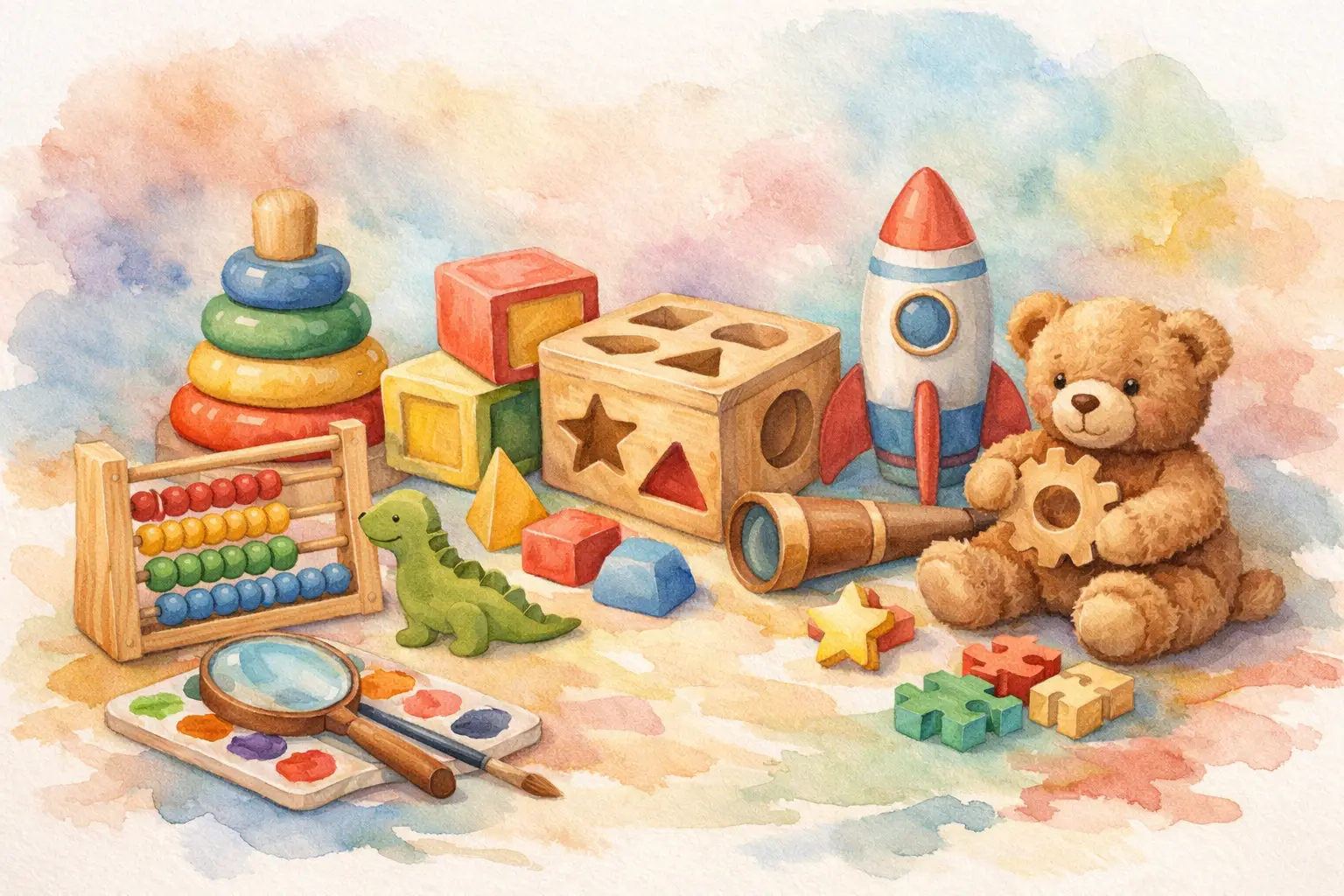
Toddlers learn by doing everything themselves — often more than once. Shape sorters, nesting cups, pull toys, beginner puzzles, and pretend play sets are ideal at this age. These choices build hand-eye coordination, fine motor skills, and early problem-solving while keeping play energetic and satisfying.
Imaginative play also begins to shine in this window. Toy food, dolls, small vehicles, and play tools encourage toddlers to recreate what they observe at home. Specifically, this kind of pretend play builds vocabulary and helps children make sense of routines, emotions, and social dynamics.
If your toddler loses interest quickly, simpler is almost always better. A toy with one clear purpose often gets far more use than a complicated toy with too many buttons and modes. The goal is not to impress adults — it is to give young children something they can master and genuinely enjoy.
Best toddler educational toys: Shape sorters · Nesting cups · Pull toys · Beginner puzzles · Pretend food sets · Push walkers · Stacking blocks For a deeper walkthrough, see our How to Choose Nursery Furniture Sets.
Preschoolers are ready for more challenge — especially when it still feels playful. Building blocks, magnetic building tiles, matching games, alphabet toys, counting sets, and beginner art supplies all fit well here. These tools support early math concepts, letter recognition, planning, and creative expression simultaneously.
Pretend play remains just as valuable at this age. Dress-up items, play kitchens, doctor kits, and doll accessories give children room to build stories, practice cooperation, and work through social situations. When kids invent their own scenarios, they are simultaneously exercising memory, language, and emotional understanding.
Additionally, this is a great age to introduce a little more structure — such as simple science sets for kids or age-appropriate board games. Just keep expectations realistic. Preschoolers may love the idea of a game but still need guidance with turn-taking, rule-following, and handling frustration gracefully.
Best preschool educational toys: Magnetic tiles · Building blocks · Alphabet puzzles · Counting sets · Play kitchens · Beginner science kits · Simple board games For a deeper walkthrough, see our Best Creative Play Toys for Toddlers.
As children reach school age, the strongest educational toys ideas offer room to expand in difficulty and complexity. Detailed building kits, STEM project sets, craft collections, beginner coding toys, logic puzzles, and strategy-based board games can sustain interest for much longer because they present new challenges over time.
These toys work especially well for children who enjoy making, testing, and improving their creations. A construction set can become a genuine lesson in patience and engineering thinking. A craft project can develop planning, focus, and aesthetic judgment. A science activity can transform everyday curiosity into real, testable understanding.
However, not every child wants a toy that feels like homework with a fun shell. If your child is hands-on but not academically driven, choose options that keep pressure low. Creative building, imaginative worlds, and movement-based games can teach plenty of valuable skills without feeling formal or forced. For a deeper walkthrough, see our Breathable Toddler Shoes That Keep Up.
Best early elementary educational toys: STEM kits · Logic puzzles · Strategy board games · Beginner coding toys · Detailed building sets · Craft collections
Below is a comprehensive list of proven educational toy categories — each one explained with the specific skills it builds and who benefits most. These are not passing trends. They are the choices families rely on year after year because they work.
Many parents search for educational toys without a clear map of what skills they are actually trying to support. Understanding these categories makes shopping far more intentional — and far less overwhelming.
Cognitive development covers memory, attention, problem-solving, and logical reasoning. Puzzles, sorting toys, strategy games, and building sets all target this domain. According to CDC guidelines on child development, children between ages 2 and 4 are particularly primed to develop foundational problem-solving and memory skills through structured play.
Language develops fastest in contexts rich with words and social interaction. Board books, pretend play sets, storytelling toys, and even simple board games — where adults narrate what is happening — powerfully accelerate vocabulary and comprehension growth.
Fine motor skills involve the small muscles of the hands and fingers. These skills are essential for writing, self-care tasks, and precise manipulation of objects. Lacing toys, art supplies, building kits, and puzzles all develop fine motor control in engaging, low-pressure ways.
Social-emotional development — including empathy, cooperation, frustration tolerance, and self-regulation — is supported by pretend play, cooperative board games, role-play sets, and sensory toys. These skills are just as important for long-term success as academic knowledge. Research from the American Psychological Association on play-based learning consistently highlights the role of play in emotional regulation development.
Spatial reasoning — the ability to mentally visualize and manipulate objects in space — is one of the strongest predictors of future success in mathematics and science. Building sets, magnetic tiles, construction kits, and even simple puzzles train this skill in ways no worksheet can replicate.
It is easy to assume that every developmental stage demands a brand-new set of purchases. In reality, many of the best educational toys ideas are highly versatile and last far longer than expected. A quality set of blocks, a pretend play collection, or a well-made puzzle set can serve children across multiple ages and stages.
When working with a budget, prioritize toys that do more than one thing. Open-ended toys consistently deliver better value because children can use them differently as they grow. A building toy begins as simple stacking for a toddler and evolves into complex architectural structures and storytelling props for a five-year-old.
A toy that is affordable but overwhelms your living room may not feel like a bargain after a week. Practical families consistently get the most value from toys that are sturdy, easy to organize, and simple enough to bring out often. Consequently, consider storage requirements before buying — especially for larger sets or multi-piece collections. For a deeper walkthrough, see our Kids Room Storage Furniture That Works.
Washability matters more than many parents initially expect — particularly for baby and toddler toys that end up in mouths, on floors, and under furniture. Construction quality also matters enormously. A toy that looks beautiful online but feels flimsy in person may not survive long enough to deliver any real educational value. In short, durable beats cheap every time.
Age recommendations on packaging are a helpful baseline, but every child develops at their own pace. A mature three-year-old may thrive with a toy labeled for ages four and up, while a sensory-sensitive five-year-old may still love toys designed for toddlers. Trust what you observe in your own child over what a label says.
Parents are not only buying for learning — they are buying for real life. That means going beyond the marketing claims and checking the actual product details. Here is a practical safety checklist to apply before every educational toy purchase:
Not every toy marketed as educational actually earns that label in practice. In particular, watch for these common patterns where the marketing promise far outpaces the real-world play experience:
Interestingly, the toy itself is only half the equation. Research consistently shows that adult interaction during play dramatically amplifies a toy’s educational impact. Even the simplest toy becomes a richer experience when a caregiver participates, narrates, asks questions, or extends the play scenario.
The best educational toys ideas for toddlers combine movement and hands-on discovery. Top choices include shape sorters, stacking rings, nesting cups, beginner puzzles, pull toys, pretend food sets, and board books. These options build fine motor skills, language, and early problem-solving while keeping play active and independently accessible.
Educational play begins from birth. Even newborns benefit from high-contrast visual stimulation, gentle sounds, and skin-to-skin interaction. As early as a few weeks old, babies respond to simple sensory toys like soft rattles and activity mats. The key is matching the toy to the child’s current developmental stage rather than rushing toward more complex options.
No. Many of the most effective educational toys — wooden blocks, shape sorters, simple puzzles, and art supplies — are affordable and widely available. The key factors are open-ended play potential, durability, and age-appropriateness, not price. In fact, simpler toys often outperform expensive tech-heavy alternatives in terms of sustained engagement and skill development.
The distinction is somewhat blurry — most good toys have some educational value because all play supports development. However, educational toys are specifically designed to target particular developmental skills such as problem-solving, language, motor development, or STEM thinking. The best educational toys feel like play to children while systematically building skills that transfer to learning contexts.
For children under age 2, the American Academy of Pediatrics recommends avoiding screens altogether (except video chatting). For older children, physical educational toys consistently outperform screen-based alternatives for motor development, social skill building, and sustained attention. Screen-based apps can supplement learning but should not replace hands-on play, especially in the early years.
Research suggests that fewer toys available at one time leads to deeper, more creative, and more focused play. A commonly recommended approach is a toy rotation system — keeping 10 to 15 items accessible at a time and rotating new sets every 2 to 4 weeks. This restores novelty, reduces overwhelm, and encourages children to engage more meaningfully with each toy they have access to.
The most effective educational toys ideas are not necessarily the most expensive, the most feature-rich, or the most widely marketed. They are the ones that match your child’s current stage, spark genuine curiosity, invite repeated independent play, and grow alongside a developing mind. A well-chosen simple puzzle your child loves will do more than an elaborate electronic gadget that holds attention for one afternoon.
Furthermore, remember that you — the parent or caregiver — are the most powerful educational tool in your child’s environment. Talking, asking questions, playing alongside, and celebrating effort amplify the value of any toy exponentially. The toy creates the opportunity; your engagement turns it into genuine learning.
At Everything Children’s Outlet, the focus is on practical, safe, and genuinely engaging choices that fit real homes and real budgets. Whether you are starting from scratch, topping up a collection, or searching for a gift that actually matters, explore the full range of children’s educational toys and essentials — and let your child’s curiosity guide the rest. For a deeper walkthrough, see our Newborn Clothing Essentials for Everyday Ease.